Key Takeaways:
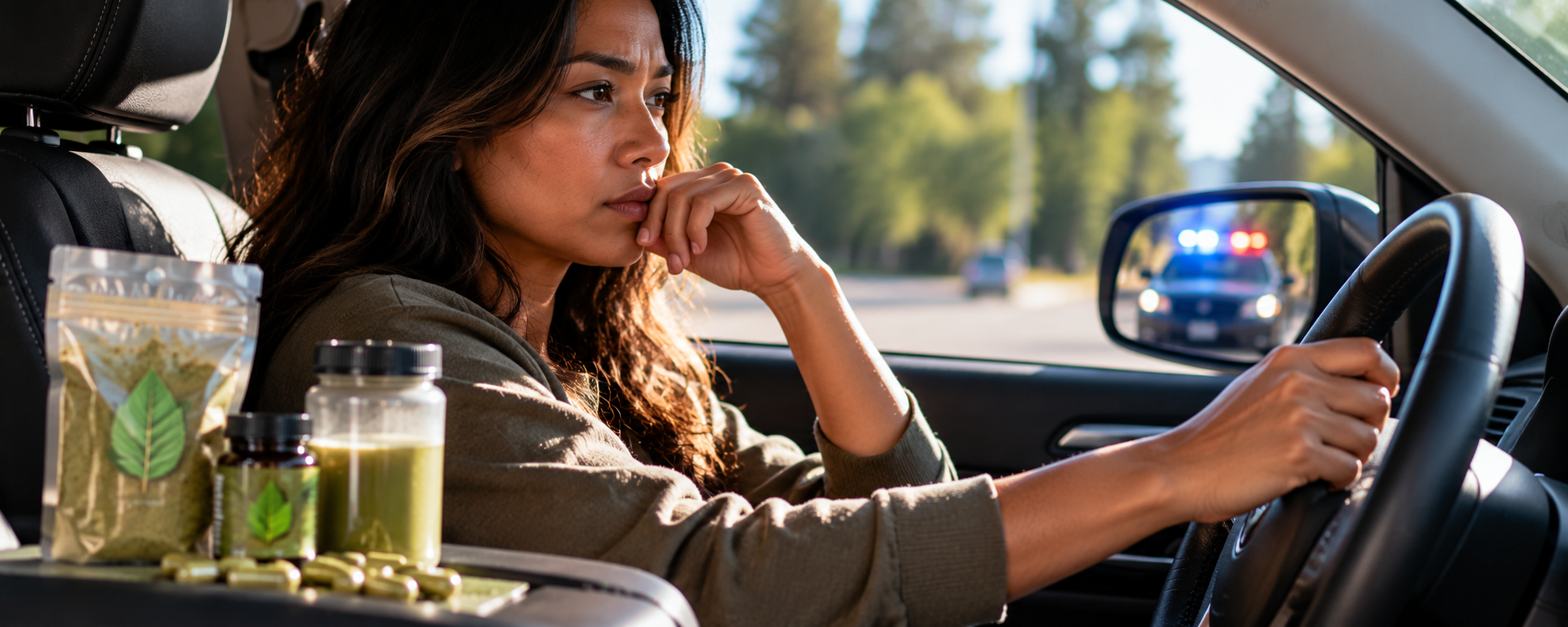
- Taking kratom is not automatically illegal in Washington, but driving while affected by kratom can lead to a DUI charge under RCW 46.61.502, which covers impairment from any drug, not just illegal ones.
- Washington does not have a kratom-specific numerical impairment threshold like it does for alcohol or THC, so there is no legally defined “safe amount” to consume before driving.
- Kratom’s effects vary significantly based on dose, product type (leaf versus concentrated extract), individual metabolism, and whether it’s combined with other substances, making impairment difficult to predict.
- A DUI conviction in Washington carries lasting consequences, including license suspension, fines, possible jail time, higher insurance costs, and a permanent mark on a person’s driving record.
Question:
Can you get a DUI for taking kratom in Washington State?
Answer:
Taking kratom doesn’t automatically make driving illegal in Washington, but the state’s DUI law, RCW 46.61.502, prohibits driving while under the influence of or affected by any drug, legal or not. While Washington’s Pharmacy Quality Assurance Commission withdrew a 2025 proposal to schedule kratom, its legal status doesn’t determine whether it’s safe to drive after use. Kratom’s alkaloids, mitragynine and 7-hydroxymitragynine, can cause drowsiness, dizziness, confusion, and reduced coordination, effects that vary by dose, product concentration, and individual factors. Because there’s no kratom-specific impairment threshold, no waiting period guarantees safety. Concentrated products like kratom shots or 7OH extracts can be especially unpredictable. Combining kratom with alcohol or other sedating substances increases risk further. Anyone who feels affected by kratom should arrange alternative transportation rather than drive, and those noticing patterns of dependence should consider reaching out to a treatment provider like Puget Sound Recovery Centers for support.
If you’ve taken kratom and you’re wondering whether it’s safe—or legal—to drive, you’re asking a more complicated question than it might seem. Two separate issues are at play here: whether kratom itself is legal, and whether kratom can impair someone enough that driving becomes unsafe or against the law.
These aren’t the same question, and confusing them can lead to real consequences. Many people assume that if a substance is legal to purchase—at a gas station, smoke shop, or online—it must be safe to use before driving. That assumption doesn’t hold up under Washington law. Washington’s DUI statute doesn’t ask whether a drug is legal. It asks whether a driver is affected by it. This distinction matters for anyone in the Puget Sound area who uses kratom, whether occasionally or regularly, and wants to understand the real risks involved.
Is Kratom Legal?
Is Kratom Legal Under Federal Law?
At the federal level, the Drug Enforcement Administration (DEA) has not classified kratom as a controlled substance under the Controlled Substances Act. The DEA notes that kratom’s two major psychoactive ingredients are mitragynine and 7-hydroxymitragynine, commonly referred to as 7OH kratom in the marketplace (DEA). That said, the DEA also acknowledges that state and local regulations vary, so a product’s federal status doesn’t guarantee it’s treated the same way everywhere.
It’s also worth distinguishing between traditional kratom leaf products—like kratom pills or raw leaf powder—and newer, more concentrated or synthetic/semi-synthetic alkaloid products, including certain 7OH kratom extracts and formulations like Opia kratom. These concentrated products often contain significantly higher levels of active alkaloids than traditional leaf, which matters when it comes to potential effects. The U.S. Food and Drug Administration (FDA) has warned that 7-hydroxymitragynine demonstrates substantially greater mu-opioid receptor potency than mitragynine and other classical opioids (FDA). The FDA has also cautioned consumers against using kratom altogether, citing risks such as liver toxicity, seizures, and substance use disorder, and notes that kratom is not lawfully marketed in the U.S. as a drug, dietary supplement, or food additive (FDA).
Regulations surrounding kratom and its specific alkaloids continue to evolve, both federally and at the state level, so what’s accurate today may shift.
Is Kratom Legal in Washington State?
Washington has, at times, considered restricting kratom more heavily. The state’s Pharmacy Quality Assurance Commission had proposed rulemaking to add kratom to Schedule I, but the Commission withdrew that proposal on March 5, 2025, after determining that kratom and its active alkaloids did not meet the state’s tests for Schedule I placement under RCW 69.50.201 and RCW 69.50.203 (Washington State Register, WSR 25-06-091).
Writer’s note: Kratom regulation is an active and evolving area of state policy. Please verify Washington’s current rules immediately before publishing, as classifications and restrictions can change.
Is It Illegal to Drive After Taking Kratom in Washington?
Taking kratom and then driving isn’t automatically a DUI based solely on the fact that you consumed kratom. But Washington law doesn’t stop at illegal substances. RCW 46.61.502 makes it a crime to drive while under the influence of or affected by any drug, a category broad enough to include legal, over-the-counter, and prescription substances alongside illicit ones.
This is where the distinction between legality of possession and legality of impaired driving becomes so important. Just because you can legally buy and use kratom doesn’t mean you’re protected from a DUI charge if it affects your ability to drive safely. Even a valid prescription for a controlled substance isn’t necessarily a defense to a DUI charge in Washington—what matters is impairment, not the legal status of what caused it.
Unlike alcohol, which has a defined blood alcohol concentration (BAC) limit, or THC, which has its own numerical threshold, Washington’s DUI statute doesn’t establish a kratom-specific impairment cutoff. That absence of a number can be misleading. It doesn’t mean there’s a safe amount of kratom to consume before driving—it means there’s no simple test to fall back on, which puts more responsibility on individual judgment.
Can You Get a DUI From a Legal Drug?
Yes. Washington DUI law isn’t limited to illegal drugs. Consider common examples: many people know that certain sedating prescription medications, or even over-the-counter allergy and sleep aids, can impair driving ability despite being entirely legal to use. The same principle applies to kratom. What matters under the law is whether a substance affects your ability to drive—not whether you obtained it legally.
Washington’s Department of Licensing (DOL) warns that drivers cannot safely operate a vehicle after using impairing drugs, regardless of legal status, and outlines a range of consequences for doing so, including license suspension, fines, criminal penalties, potential jail time, and increased insurance costs (Washington State Department of Licensing).
Does Kratom Impair Your Ability to Drive?
Kratom Can Produce Different Effects at Different Doses
Kratom’s effects come largely from its active alkaloids, primarily mitragynine and 7-hydroxymitragynine. Users and manufacturers often describe kratom as having stimulant-like effects at lower doses and more sedating, opioid-like effects at higher doses. This dose-dependent variability is part of what makes kratom’s impact on driving so unpredictable.
Kratom doesn’t affect everyone the same way. Product concentration, the specific dose taken, individual tolerance, metabolism, and whether kratom is combined with other substances can all shape how a person responds. Someone who has used kratom regularly for months may react very differently than someone trying it for the first time, and a kratom vape or kratom shot may hit differently than a slower-acting capsule.
Kratom Side Effects That Could Make Driving Dangerous
Several reported kratom side effects are directly relevant to safe driving, including:
- Drowsiness or sedation
- Dizziness
- Confusion
- Reduced coordination
- Changes in alertness
- Nausea
- Changes in attention or concentration
Each of these effects connects to a specific driving task. Drowsiness and reduced alertness can affect a driver’s ability to maintain a lane or notice a light change in time. Dizziness and reduced coordination can interfere with steering and braking precision. Confusion and concentration changes can slow a driver’s ability to judge distance, monitor pedestrians, or respond appropriately to sudden hazards like a car stopping short or a cyclist entering the roadway.
Does Kratom Slow Your Reaction Time?
Reaction time is one of the most critical factors in safe driving—it’s the difference between avoiding a collision and being involved in one. Unfortunately, research specifically measuring kratom’s effects on real-world driving performance remains limited. Because of this gap, it’s not possible to state a precise reaction-time reduction associated with kratom use, and any claim that does so should be treated with skepticism.
What’s important to understand is this: the absence of a kratom-specific BAC-style cutoff does not mean someone is safe to drive. It simply means science and law haven’t caught up with the substance’s growing use. A lack of a legal number is not the same as a lack of risk.
How Long After Taking Kratom Is It Safe to Drive?
There isn’t a scientifically established universal number of hours after which everyone is safe to drive following kratom use. Several factors influence how long effects may last, including:
- The amount consumed
- The product’s strength and formulation
- Whether it’s traditional leaf or a concentrated extract
- Individual metabolism
- Frequency of kratom use
- Other medications or substances in a person’s system
Because these variables differ so much from person to person, no responsible source should tell you to “wait X hours and you’re safe.” The more practical guidance is to pay attention to how you feel. If you feel sedated, dizzy, confused, unusually stimulated, uncoordinated, or otherwise affected in any way, that’s a sign you shouldn’t get behind the wheel, regardless of how much time has passed.
Kratom Shots and Extracts May Be Especially Difficult to Judge
Traditional kratom leaf, typically found in powders or pills, differs meaningfully from newer concentrated extracts like kratom shots or high-potency formulations. A small bottle of a kratom shot doesn’t necessarily mean a small amount of active alkaloids. In fact, some concentrated extracts pack far more potency into a smaller serving than their size suggests.
Concentrations can vary widely between products and brands, and labeling isn’t always consistent or easy to interpret. This means consumers shouldn’t assume that one “shot,” capsule, or serving will produce a predictable level of impairment, especially if they’re switching between products or trying something new. This variability is part of why there isn’t a simple kratom equivalent to a BAC chart. Without standardized potency, there’s no reliable way to calculate impairment from dose alone.
Reach Out For Help With Addiction
Are you or a loved one struggling with addiction?
Royal Life Centers at Puget Sound is here to help you recover. Because we care.
What Happens If You Mix Kratom With Alcohol or Other Drugs Before Driving?
Combining kratom with other psychoactive substances introduces additional risk and unpredictability, including:
- Alcohol and kratom: Both can produce sedating effects, and combining them may intensify drowsiness and impair coordination beyond what either substance would cause alone.
- Kratom and opioids: Because kratom interacts with opioid receptors, combining it with prescription or illicit opioids can compound sedation and respiratory risks.
- Kratom and benzodiazepines: Mixing central nervous system depressants can significantly heighten sedation and slow reaction time.
- Kratom and sleep medications or other sedating drugs: Layering sedating substances can make someone far less capable of responding to sudden road hazards, even if they feel only mildly affected.
Combining psychoactive substances tends to make impairment less predictable, not more manageable. It’s also worth noting that Washington law specifically addresses driving under the combined influence of alcohol and drugs, meaning that mixing substances doesn’t create a legal loophole. If anything, it can compound the risk of a DUI charge.
How Dangerous Is Impaired Driving?
What Do Impaired Driving Statistics Show?
Impaired driving carries serious, measurable consequences on American roads. In 2024, 11,904 people were killed in alcohol-impaired-driving crashes in the United States—roughly one death every 44 minutes. Alcohol-impaired drivers were involved in 30% of all U.S. traffic fatalities that year (National Highway Traffic Safety Administration).
It’s important to note that these figures reflect alcohol-impaired driving specifically, not kratom-related crash statistics. There is currently no equivalent nationwide data tracking kratom’s specific role in traffic fatalities.
Is Drug-Impaired Driving a Broader Problem Than Alcohol Alone?
Impairment on the road isn’t limited to alcohol. The National Highway Traffic Safety Administration (NHTSA) reports that among seriously or fatally injured road users studied at trauma centers between October and December 2020, 56% tested positive for at least one drug, with alcohol, cannabinoids, and opioids among the most prevalent substances detected (NHTSA).
This broader pattern of drug-impaired driving highlights a real challenge with emerging substances like kratom: without an established roadside impairment threshold or standardized test, law enforcement and courts must rely on other evidence of impairment, such as officer observations and field sobriety performance, rather than a simple number.
What Are the Consequences of a DUI in Washington?
A DUI conviction in Washington can carry significant, long-lasting consequences, including:
- Arrest and criminal charges
- Driver’s license suspension or revocation
- Fines and associated legal costs
- Possible jail time
- Increased auto insurance premiums
- Ignition-interlock device requirements in applicable cases
- Long-term impacts on your driving record
According to the Washington State Department of Licensing, alcohol- and drug-related driving offenses remain on a person’s driving record for life (Washington State Department of Licensing). This isn’t a temporary mark that fades after a few years; it’s a permanent record that can affect employment, insurance rates, and other areas of life well beyond the initial charge.
What Should You Do If You’ve Taken Kratom and Don’t Feel Safe to Drive?
If you’ve used kratom—whether in pill form, as a kratom vape, or as part of kratom beverages—and you’re unsure whether you’re fit to drive, keep these points in mind:
- Don’t try to determine impairment based solely on whether kratom is legal. Legality and safety are two different questions.
- Don’t assume that feeling “mostly normal” means you’re safe to drive. Subtle impairment can still affect reaction time and judgment.
- Arrange a sober ride instead: call a rideshare, take a taxi, use public transportation, or simply wait somewhere safe until you feel clear-headed.
- Never combine kratom with alcohol or other impairing substances before getting behind the wheel.
- Seek medical assistance immediately for severe reactions such as loss of consciousness, seizures, severe confusion, or breathing problems.
It’s also worth knowing that some employers and organizations now screen for kratom compounds. If you’re concerned about a kratom drug test in a work or legal context, that’s a separate conversation worth having with a knowledgeable professional, but it underscores how seriously kratom use is increasingly being treated.
When Kratom Use Becomes More Than Occasional
For some people, kratom use shifts from occasional to habitual without them fully realizing it. Signs that kratom use may have become problematic include:
- Needing kratom every day just to feel normal
- Taking progressively larger amounts over time
- Moving from leaf products to stronger extracts like kratom vapes or concentrated shots
- Experiencing cravings between uses
- Feeling withdrawal symptoms when stopping
- Continuing to use despite negative consequences
- Driving or engaging in other risky activities while impaired
- Making unsuccessful attempts to cut back
If any of these patterns feel familiar, they may indicate dependence or a problematic relationship with kratom use—one that deserves compassionate, professional attention rather than judgment.
The Bottom Line: Legal Doesn’t Mean Safe to Drive
Whether kratom is legal in Washington doesn’t determine whether it’s legal or safe for someone to drive after taking it. Washington’s DUI law applies to anyone driving while under the influence of or affected by any drug, and there is no kratom-specific impairment threshold written into that law. If kratom is noticeably affecting your alertness, coordination, judgment, or ability to react, the safest and most responsible choice is to not get behind the wheel.
This article is intended for informational purposes only and does not constitute legal advice. If you have questions about a specific legal situation, please consult a qualified attorney.
Concerned About Your Kratom Use? Learn About Treatment Options in Washington
Recognizing that kratom has taken on a bigger role in your life than you intended isn’t a failure—it’s an important moment of self-awareness. At Puget Sound Recovery Centers, we understand how substances like kratom, even ones with murky legal status, can quietly become something harder to manage than expected. Our team is here to help you understand your options with compassion and without judgment.
If you’re ready to take the next step, our admissions process is designed to be simple and supportive, guiding you from your very first phone call through personalized care. We also know that cost concerns can hold people back, which is why we offer an easy way to verify your insurance before you commit to anything.
Every guest who comes to us deserves a treatment path built around their unique needs. Learn more about choosing the right addiction treatment near Tacoma, WA, explore our drug addiction therapy programs, or find out more about drug addiction rehab options built for lasting recovery. If you’re searching for addiction rehab near me in the Puget Sound area, we’re here, ready to help, day or night.
Frequently Asked Questions
Is kratom an opioid?
Kratom is not classified as a traditional opioid, but its active alkaloids, particularly 7-hydroxymitragynine, interact with opioid receptors in the brain. The FDA notes that 7-hydroxymitragynine shows substantially greater mu-opioid receptor potency than mitragynine and even some classical opioids, which is part of why kratom’s effects and risks are taken seriously by health authorities.
Is kratom legal to buy and use in Washington?
As of the most recent update to this article, Washington’s Pharmacy Quality Assurance Commission withdrew its proposal to classify kratom as a Schedule I substance in March 2025. However, kratom regulation continues to evolve, so readers should verify the current legal status before assuming any particular product or formulation is unrestricted.
Can a kratom drug test detect recent use?
Specialized drug tests can detect kratom’s active alkaloids, though kratom is not typically included in standard workplace drug panels. Testing methods and detection windows vary by lab and test type.
What are the risks of using concentrated products like Opia kratom or 7OH kratom before driving?
Concentrated extracts and formulations often contain significantly higher levels of active alkaloids than traditional kratom leaf. This can lead to stronger, less predictable effects, including sedation or impaired coordination, making it especially unwise to assume a “small” serving equals a small effect.
What should I do if I think I have a problem with kratom?
If you’re experiencing cravings, tolerance, withdrawal, or using kratom despite negative consequences, reaching out to a treatment professional is a healthy and proactive step. Puget Sound Recovery Centers offers a supportive admissions process to help guests explore treatment options tailored to their needs.
REFERENCES:
- Drug Enforcement Administration. Kratom (Mitragyna Speciosa Korth). U.S. Department of Justice, ndc/dea.gov.
- National Highway Traffic Safety Administration. 2024 Fatality Data: Alcohol-Impaired Driving. U.S. Department of Transportation, 2024, www.nhtsa.gov.
- National Highway Traffic Safety Administration. Drug and Alcohol Crash Risk Study: Trauma Center Data, October–December 2020. U.S. Department of Transportation, 2021, www.nhtsa.gov.
- U.S. Food and Drug Administration. FDA and Kratom. U.S. Department of Health and Human Services, www.fda.gov.
- Washington State Department of Licensing. Driving Under the Influence (DUI) in Washington State. Washington State Department of Licensing, www.dol.wa.gov.