Key Takeaways:
- Kratom sold today spans a wide spectrum of formulations—from traditional leaf powder and capsules to concentrated 7-OH tablets and shots—and these forms carry meaningfully different risk profiles, despite sharing the same “kratom” label.
- Brands like Opia Kratom and Feel Free sell concentrated or 7-OH-containing products with explicit habit-forming warnings on their own packaging, while brands like Nova Kratom, Kraken Kratom, Earth Kratom, and Payless Kratom primarily sell traditional powders and capsules.
- According to the CDC, kratom-related poison center reports rose approximately 1,200% between 2015 and 2025, with the 2025 surge tied directly to the emergence of high-potency 7-OH formulations, and 62% of kratom-associated deaths involved opioids.
- Retail availability at gas stations and smoke shops doesn’t indicate safety—kratom occupies a regulatory gray area, and consumers should learn to read alkaloid content, dosing guidance, and warning labels before purchasing.
Question:
Are gas station kratom brands dangerous?
Answer:
Kratom products sold at gas stations, smoke shops, and online retailers have expanded far beyond the traditional powder once associated with the plant. Today’s kratom brands include concentrated 7-hydroxymitragynine (7-OH) tablets and shots, flavored beverages, vapes, capsules, and extracts—each with a distinct risk profile. Brands like Opia Kratom and Feel Free sell 7-OH or kava-kratom blends with explicit habit-forming warnings, while Nova Kratom, Kraken Kratom, Earth Kratom, and Payless Kratom focus on traditional powders and capsules. According to the CDC, kratom-related poison center reports rose roughly 1,200% from 2015 to 2025, coinciding with the rise of high-potency 7-OH products, and NIDA confirms kratom can cause dependence and withdrawal. Because kratom’s availability doesn’t reflect its safety, consumers should carefully evaluate alkaloid content and warning labels. For those whose kratom use has become difficult to control, professional treatment and support are available.
If you’ve walked past the counter of a gas station recently, you may have noticed something new sitting beside the energy drinks and vape pens: brightly labeled bottles and pouches marked “kratom.” Maybe you’ve seen them in a smoke shop, too, stacked near CBD products and rolling papers. Or perhaps you’ve scrolled past an online ad for a kratom brand promising focus, calm, or a natural boost.
Kratom has quietly become one of the most widely available—and least understood—substances sold in everyday retail spaces. It’s not regulated the same way as alcohol or tobacco, and it’s certainly not treated with the same caution as a prescription medication. Yet the products sold under the “kratom” label today are far more varied, and in some cases far more potent, than the plant material this word originally described.
This guide breaks down what kratom actually is, where it’s sold, which brands consumers commonly encounter, and why the differences between kratom leaf, extracts, and 7-OH products matter more than most shoppers realize. Understanding these distinctions can help protect you or someone you love from an experience that may look casual on the shelf, but which carries real risks behind the label.
What Is Kratom?
Kratom (Mitragyna speciosa) is a tropical tree native to Southeast Asia, where its leaves have traditionally been chewed or brewed into tea. According to the National Institute on Drug Abuse (NIDA), kratom produces both stimulant-like and opioid-like effects depending on the dose, and its two primary active compounds are mitragynine and 7-hydroxymitragynine (7-OH).
Mitragynine is the dominant alkaloid found naturally in the kratom leaf. 7-OH, by contrast, is present only in small amounts in the raw plant, but it activates the brain’s mu-opioid receptors—the same receptors targeted by drugs like morphine and oxycodone (NIDA). This distinction matters enormously, and it’s one that most consumers browsing a gas station shelf never see explained.
Kratom is not currently approved by the FDA for any medical use, and the DEA classifies it as a “drug of concern” rather than a controlled substance (NIDA). That regulatory gray area is precisely why kratom products can be sold so freely, in so many forms, in so many places.
Where Are Kratom Products Sold?
Gas Stations and Convenience Stores
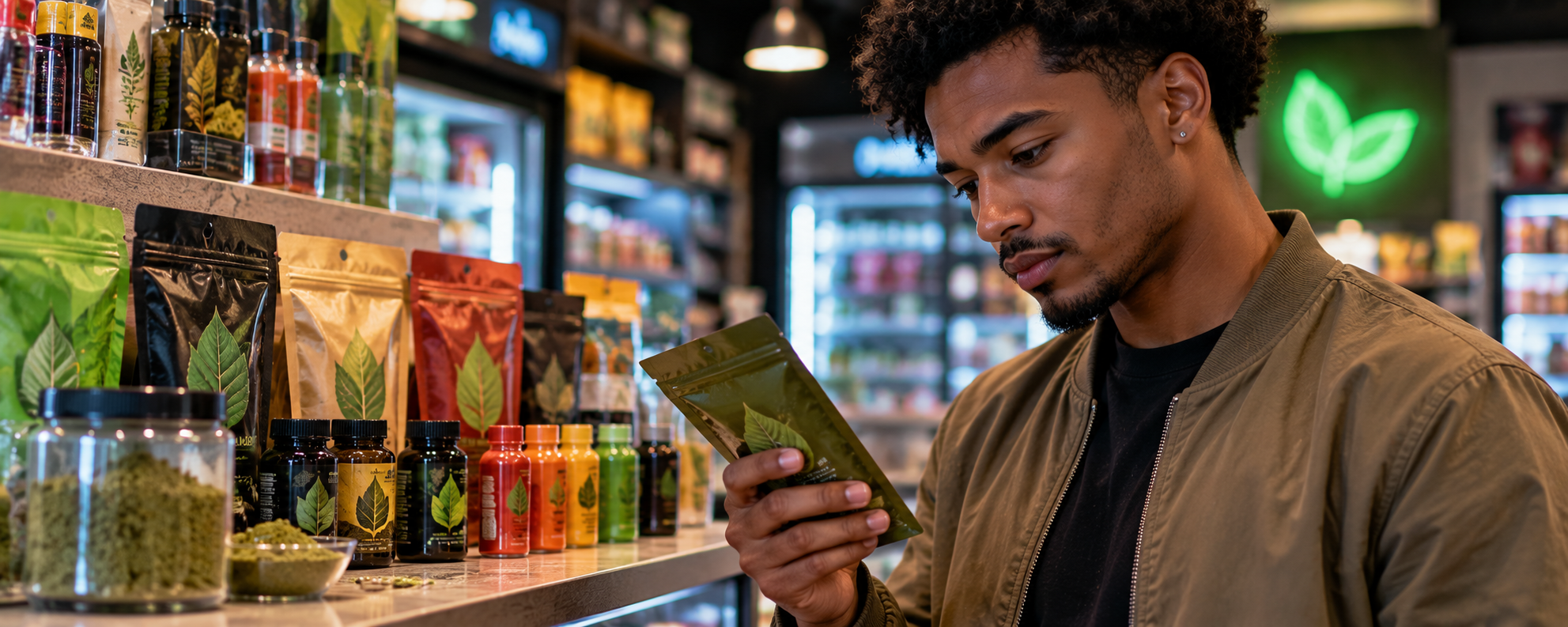
Gas station kratom has become a familiar sight in many parts of the country. These products are typically displayed near the checkout counter alongside energy shots, supplements, and vape products. The accessibility is part of the appeal—and part of the concern. A shopper stopping for coffee or gas may pick up a kratom shot on impulse, with little more than a glance at the label and no conversation with a pharmacist or medical professional.
Smoke Shops and Vape Stores
Kratom at smoke shops is often sold alongside CBD, delta-8, and vape products, which can create the impression that these substances belong to the same low-risk category. Smoke shops frequently carry a wider variety of kratom products than gas stations, including powders, capsules, extracts, and increasingly, kratom vape products.
Online Kratom Retailers
Kratom products online offer the widest selection by far—multiple brands, strains, formats, and potencies, often at lower prices than in-store options. Online retailers may also provide more product information, including lab testing and ingredient breakdowns, though the quality and transparency of this information varies significantly from brand to brand.
Popular Kratom Brands Consumers May Encounter
Kratom brands differ substantially in what they actually sell, and understanding these differences is essential to understanding your own risk.
Opia Kratom
Opia Kratom sells concentrated 7-OH tablets and flavored liquid shots. Its Classic tablet product contains 80mg of 7-OH total, with 20mg per tablet and a recommended serving size of just half a tablet (10mg). Opia’s liquid shots come in flavors like Blueberry Lemonade, Mango Strawberry, Strawberry Watermelon, and Raspberry Peach. All products require age verification for buyers 21 and older, and Opia’s own packaging states: “THIS PRODUCT CONTAINS KRATOM. KRATOM MAY BE ADDICTIVE. PRODUCT NOT INTENDED FOR DAILY USE.” Opia products are not sold in Alabama, Arkansas, Indiana, Rhode Island, Wisconsin, and certain counties.
Feel Free
Feel Free, made by Botanic Tonics, sells a “Classic” tonic containing both kava root and leaf kratom, along with caffeine-free and naturally caffeinated capsule options. Feel Free’s own packaging warns that its products “CAN BE HABIT-FORMING,” instructs users to “CONSUME RESPONSIBLY,” and states the product is “FOR ADULTS 21+ ONLY.” The brand also warns against use by anyone with a history of substance abuse, and notes that its products have not been evaluated by the FDA. Notably, Feel Free’s own website acknowledges that the DEA has taken steps to schedule concentrated synthetic 7-OH.
Kraken Kratom
Kraken Kratom is a longstanding retailer known for powder and capsule products. As with any kratom brand, consumers should verify current product lines, alkaloid content, and lab testing directly with the retailer before purchasing, since formulations and potency can change over time.
Payless Kratom
Payless Kratom is an online retailer carrying multiple kratom brands, including liquid extract shots such as its White Diamond 99.9 Kratom Extract Shot—a 10mL, high-mitragynine concentrate that the manufacturer states contains less than 1% 7-OH. Payless also sells a wide range of capsules and powders at competitive prices, though it does not ship to Alabama, Arkansas, Florida, Indiana, Louisiana, Rhode Island, Utah, Vermont, or Wisconsin.
Nova Kratom
Nova Kratom sells kratom powder and capsules organized by strain color—red, green, white, and yellow vein—and strain name, such as Red Hulu, Red Maeng Da, and Green Maeng Da. Products are available in 250g, 500g, and 1000g powder sizes, and in 250, 500, and 1000 capsule counts. It’s worth noting that strain names and vein colors are marketing descriptors used to suggest certain effects, but they don’t provide a complete or standardized measure of a product’s actual pharmacological effects or safety.
Earth Kratom
Earth Kratom is another established name in the powder and capsule market. As with Kraken Kratom, consumers should independently verify potency, sourcing, and current regulatory status before purchase, since product details can shift.
Reach Out For Help With Addiction
Are you or a loved one struggling with addiction?
Royal Life Centers at Puget Sound is here to help you recover. Because we care.
Kratom Doesn’t Come in Just One Form Anymore
A decade ago, kratom largely meant a bag of green powder. Today, the category includes kratom powder, kratom pills and kratom capsules, kratom shots and kratom drinks, kratom vape products, and concentrated extracts. This expansion has made kratom more approachable for casual buyers—but it has also made the category far harder to evaluate at a glance.
Does Having More Ways to Take Kratom Increase Its Risks?
Different Formats Appeal to Different Consumers
A flavored kratom shot at a gas station appeals to a different buyer than a bulk bag of kratom powder from an online retailer. Kratom beverages and kratom vapes, in particular, may attract younger or more casual users who wouldn’t otherwise seek out a traditional botanical supplement.
Concentrated Products Can Change the Risk Profile
Extracts and 7-OH-dominant products deliver a much higher concentration of active alkaloids than traditional leaf powder. The CDC notes that a surge in kratom-related poison center reports in 2025 coincided directly with the emergence of these high-potency 7-OH formulations.
Familiar Formats Can Change Risk Perception
When kratom is packaged as a fruity shot or a sleek vape pen, it can look and feel similar to an energy drink or nicotine product—formats consumers already associate with everyday, low-risk use. That familiarity can obscure the fact that some of these products interact with opioid receptors in the brain.
Could Someone Accidentally Consume a Kratom Product?
Yes. Kratom products, especially flavored shots and beverages, are frequently packaged in ways that resemble common drinks or supplements, which increases the chance of accidental or unintended consumption.
Why Children and Teens Are a Particular Concern
Flavored kratom shots and drinks can be mistaken for juice or energy drinks by children, and their easy accessibility at gas stations and smoke shops means teens may encounter them with little friction. If you suspect an accidental ingestion, contact Poison Control immediately at 1-800-222-1222 or visit PoisonHelp.org.
Why ‘It’s Sold at a Gas Station’ Doesn’t Mean It’s Harmless
Retail placement often signals safety to consumers, even when it shouldn’t. Kratom’s availability at gas stations and smoke shops reflects a regulatory gap, not a safety endorsement. According to the CDC’s March 2026 MMWR report, kratom-related exposure calls to U.S. poison centers rose from 258 in 2015 to 3,434 in 2025—an increase of approximately 1,200%—with a record high reached in 2025. Over an 11-year period, poison centers logged 14,449 total kratom-related reports and identified 233 kratom-associated deaths, 79% of which involved multiple substances, and 62% of which involved opioids specifically.
Kratom Leaf vs. Extracts vs. 7-OH Products: Why the Difference Matters
Traditional kratom leaf contains a broad mix of alkaloids, with mitragynine as the dominant compound and only trace amounts of 7-OH. Extracts concentrate these alkaloids into a smaller volume, increasing potency. 7-OH-dominant products go a step further, isolating and boosting the compound that most directly activates opioid receptors in the brain (NIDA). Choose caution over convenience if a product’s label emphasizes 7-OH content prominently, since these formulations carry a meaningfully different risk profile than traditional leaf powder—particularly for anyone with a history of substance use.
Can You Become Dependent on Kratom?
Yes. NIDA documents that regular kratom use can lead to dependence, and that withdrawal symptoms have been observed in people who stop using it after consistent use. Because kratom acts on opioid receptors, its potential for dependence increases with higher doses, more frequent use, and more concentrated formulations like 7-OH products.
How to Read a Kratom Product Label
A few practices can help you evaluate a kratom product more carefully:
- Look for alkaloid content. Labels that specify mitragynine or 7-OH percentages (like Payless Kratom’s stated “less than 1% 7-OH”) offer more transparency than vague branding.
- Check for dosing guidance. Products like Opia Kratom’s tablets specify exact milligram amounts per serving—information that should never be skipped.
- Read the warnings, not just the front label. Phrases like “may be habit-forming” or “not intended for daily use” are meaningful disclosures, not fine print to ignore.
- Note what’s missing. A lack of lab testing, alkaloid percentages, or manufacturer information is itself a warning sign.
Signs Kratom Use May Be Becoming a Problem
If you or someone you care about is using kratom regularly, watch for:
- Needing more product to feel the same effects
- Using kratom to manage withdrawal from opioids or other substances
- Feeling unable to stop or cut back despite wanting to
- Withdrawal symptoms like irritability, muscle aches, or anxiety between uses
- Spending significant time or money seeking out kratom products
- Continuing use despite negative effects on work, relationships, or health
These signs don’t require judgment—they require support. If any of this sounds familiar, it may be time to explore what treatment for substance use actually looks like.
Is Kratom Legal?
Kratom’s legal status varies by state and even by county. It remains unregulated at the federal level for general sale, though the FDA has taken steps to restrict certain 7-OH products specifically, and several states and localities have enacted their own restrictions or bans.
Is Kratom an Opioid?
Kratom isn’t classified as an opioid in the traditional sense, but its 7-OH compound activates the same mu-opioid receptors as prescription opioids and heroin, which is why NIDA describes its effects as opioid-like at higher doses.
Does Kratom Show Up on a Drug Test?
Standard drug tests typically don’t screen for kratom’s specific alkaloids, though some specialized tests can detect mitragynine. This shouldn’t be mistaken for a sign of safety—kratom’s absence from routine testing has no bearing on its potential for dependence or interaction with other substances.
The Bottom Line: Kratom Is a Product Category, Not a Single Product
Perhaps the most important thing to understand about kratom is that there is no single “kratom experience.” A bag of Nova Kratom green vein powder and a 7-OH shot from Opia Kratom belong to entirely different risk categories, even though both wear the same label. Treating every kratom product as equivalent is where much of the confusion—and much of the danger—begins.
If kratom use has become part of a pattern that feels hard to control, you’re not alone, and support is available. At Royal Life Centers at Puget Sound, we understand that substance use rarely fits into neat categories, and neither does recovery. Our team works with each guest individually to understand their full history and build a plan that actually fits their life. Whether you’re just beginning to ask questions or you’re ready to take the next step, our admissions process is designed to be simple, supportive, and judgment-free.
Understanding what to look for in addiction treatment can feel overwhelming on your own, but you don’t have to figure it out alone. Our team can also verify your insurance benefits quickly and confidentially, so cost concerns don’t stand between you and getting help. From therapy that addresses the root causes of substance use to comprehensive rehab programs near you, recovery is possible—and it starts with a single conversation.
If you or someone you love is struggling, reach out for drug addiction rehab support today. Because we care.
REFERENCES:
- National Institute on Drug Abuse. “Kratom.” National Institutes of Health, nida.nih.gov/research-topics/kratom.
- Centers for Disease Control and Prevention. “Notes from the Field: Increase in Kratom-Related Exposure Calls to U.S. Poison Centers, 2015–2025.” Morbidity and Mortality Weekly Report, 26 Mar. 2026. https://www.cdc.gov/mmwr/volumes/75/wr/mm7511a1.htm